
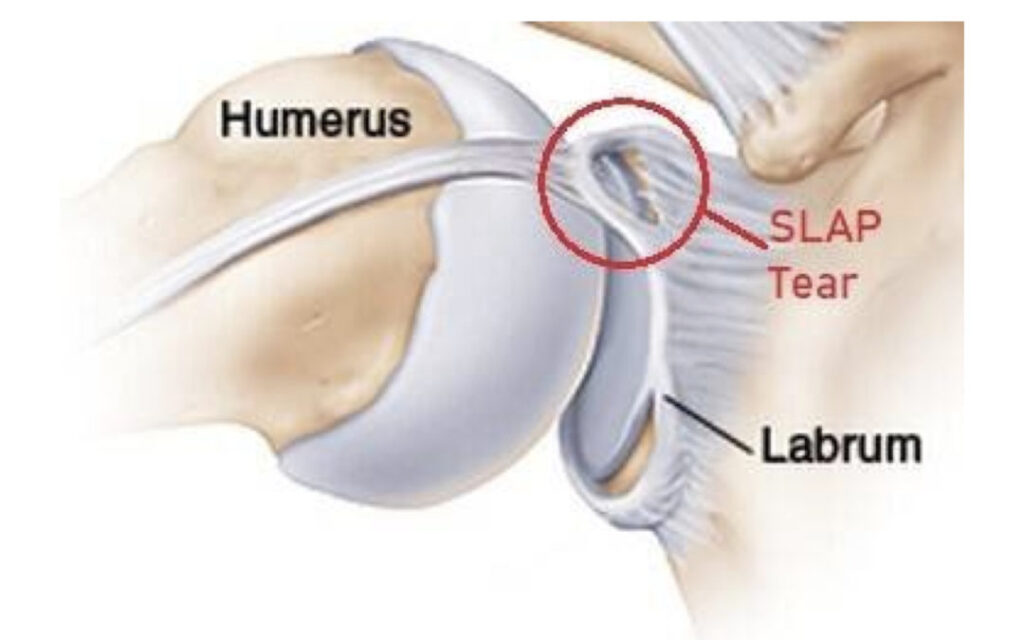
Labrum Tear / SLAP Tear – What It Means and What You Can Do About It
Shoulder pain after a fall, sudden pulling injury, or just a slow build-up of discomfort at the front or deep inside the joint? Been told you might have a labrum or SLAP tear? Let’s break it down in plain English.
🧠 First, What Is the Labrum?
Think of your shoulder joint like a golf ball sitting on a shallow tee. The labrum is a fibrocartilage rim that sits around the edge of the socket (the glenoid), helping deepen it and stabilize the ball (your humeral head). It also acts as an anchor point for key ligaments and your long head of biceps tendon.
A SLAP tear (Superior Labrum from Anterior to Posterior) is a specific type of labral tear that occurs at the top of the socket where the biceps tendon attaches.
🤕 Common Mechanisms of Injury
Labral tears—particularly SLAP tears—often happen from:
- A fall onto an outstretched arm
- Heavy or awkward lifting (especially overhead)
- Sudden pulling or traction injuries (e.g. grabbing a falling object)
- Repetitive overhead motions (throwing, CrossFit, climbing, swimming)
- Shoulder dislocations or instability episodes
Sometimes, labral degeneration occurs gradually with age or repetitive use, especially in people over 35.
🔍 Signs and Symptoms – What Might You Feel?
People with labral or SLAP tears often describe:
- Deep, vague pain inside the shoulder
- Clicking, catching, or mechanical symptoms
- Pain with overhead or behind-the-back movements
- A feeling of instability or “dead arm” in throwing athletes
- Sometimes associated biceps or front-of-shoulder tenderness
But here’s the important bit: Not everyone with a labral tear on MRI has symptoms. And not everyone with shoulder pain has a labral tear.
🧪 Clinical Tests – Are They Reliable?
In the clinic, we use several special tests to screen for SLAP tears:
- O’Brien’s Active Compression Test
- Crank Test
- Speed’s Test (for biceps involvement)
- Biceps Load Test II
These aren’t diagnostic in isolation—they’re pieces of a puzzle. What really matters is how these tests fit in with your story, your movement patterns, and how your shoulder responds to load.
📷 Imaging and Diagnostic Tests
An MRI arthrogram (MRI with contrast injected into the joint) is considered the best imaging to visualise a SLAP tear. But even then:
- False positives are common, especially over the age of 40
- Some labral “tears” are actually normal variants
- A scan may show a tear that’s not actually causing your pain
So while imaging can be useful, it should support—not dictate—the diagnosis or treatment plan.
🛠️ Treatment Options – What the Evidence Says
Most guidelines now recommend conservative management first for labral tears—unless there’s frank instability, repeat dislocations, or a large traumatic injury in an elite athlete.
✅ Non-Surgical Management
- Tailored physiotherapy, focused on:
- Rotator cuff and scapular strengthening
- Load tolerance and movement control
- Gradual return to overhead activity or sport
- Short-term pain relief via taping, manual therapy, or isometrics
- Anti-inflammatories, as needed early on
- Patient education to help understand the condition and recovery process
Studies show that many people with SLAP tears visible on imaging make excellent improvements with rehab alone—even high-functioning athletes.
⚾ Side Note: What About Throwing Athletes?
In elite overhead athletes—like professional baseball pitchers—surgery for SLAP tears is far less reliable. Research shows only 22–48% return to their previous level after SLAP repair.
That’s because surgical tightening or reattachment of the labrum or biceps tendon can alter the finely tuned mechanics needed for throwing velocity and control.
For this reason, biceps tenodesis is now more commonly performed in athletes over 30, while others opt for a comprehensive rehab approach focused on kinetic chain control, scapular mechanics, and sport-specific load.
Surgery may still have a role—but it’s rarely a first step for throwers.
⚠️ When Might Surgery Be Considered?
Surgery may be explored if:
- Symptoms persist despite 3–6 months of structured rehab
- There’s significant instability or mechanical locking
- The person is a high-level athlete with a confirmed traumatic tear
- Imaging shows a large labral tear with clear symptom correlation
Even then, surgical decisions are nuanced. Biceps tenodesis often yields better outcomes than SLAP repair in older adults, and not all tears require repair.
🏋️♂️ The Role of Physiotherapy – Why It’s Often Enough
At Melbourne Shoulder Rehab, we treat many people with SLAP or labral tears who go on to make a full recovery—without surgery.
I’ll be upfront with you—I have a SLAP tear too.
It happened over 10 years ago during a climbing fall. I felt a pop, and later imaging confirmed the tear. But I chose rehab, not surgery—and with the right approach, my shoulder has been strong and pain-free ever since.
That experience shapes how I work with patients. I know what it’s like to feel unsure about your shoulder, to doubt whether you can get back to doing what you love. My goal is to help you rebuild not just your strength, but your trust in your shoulder.
Here’s what we focus on in rehab:
- Getting you out of pain first
- Targeted strengthening of your rotator cuff and scapular stabilisers
- Gradual reloading based on your sport or activity
- Identifying and modifying the things that might be irritating your shoulder
- Coordinating with your GP or surgeon if further investigations are needed
With a clear, evidence-informed plan, many labral tears can become functionally irrelevant—and you can get back to life without worrying about what your scan says.
✅ Key Takeaways
- A labral or SLAP tear doesn’t automatically mean surgery
- Your symptoms, not just your imaging, guide your care
- Physiotherapy is highly effective—I’ve been through it myself
- Surgery is reserved for specific cases, and even then, it’s not always a quick fix
- If you’re a throwing athlete, you’ll need a tailored approach with sport-specific rehab
🤝 Let’s Help You Take the Next Step
Don’t let the word “tear” scare you. We’re here to help you move forward with clarity and confidence—whether that’s rehab, imaging, or getting a second opinion.
👉 Book your consultation today at Melbourne Shoulder Rehab
Let’s figure out what your shoulder needs—together.