
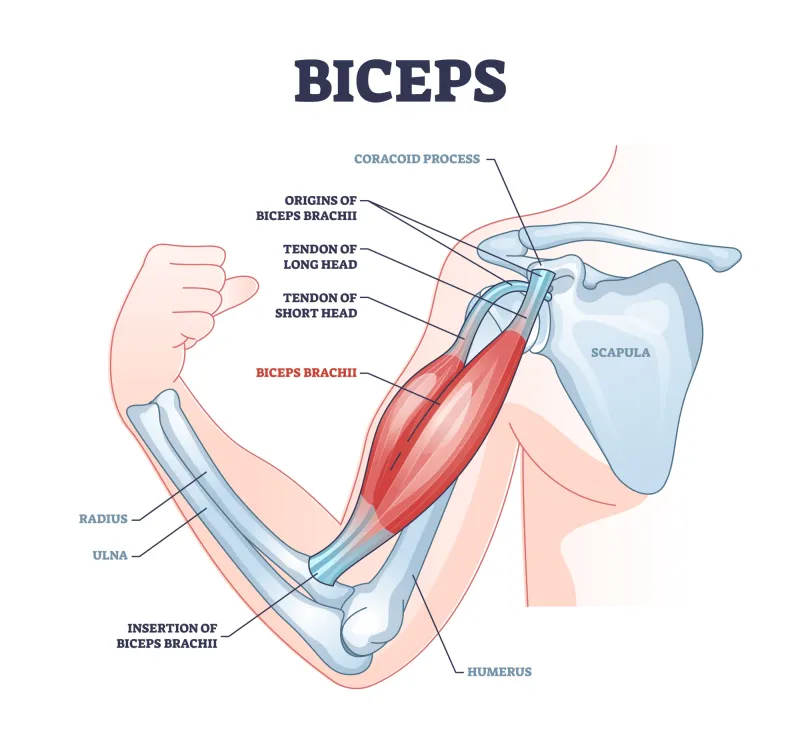
💡 What Is a Biceps Tear?
A biceps tendon tear refers to a partial or complete rupture of one of the tendons connecting your biceps muscle to your shoulder or elbow. Depending on the type of tear, it may affect your strength, function, and the appearance of your arm — and it may or may not need surgery.
This article will help you understand:
- The types of biceps tendon tears
- What causes them (based on current science)
- What signs and symptoms to watch for
- The pros and cons of surgery vs physiotherapy
- When to seek further advice
🔍 Types of Biceps Tendon Tears
There are two main types of biceps tendon tears, depending on where the tendon has ruptured:
1. Proximal Biceps Tear (Shoulder)
- Usually involves the long head of biceps (LHB), which travels through the shoulder joint and attaches to the top of the shoulder socket.
- This is the most common type of biceps tear.
- Often occurs alongside rotator cuff problems or in people with longstanding shoulder discomfort.
2. Distal Biceps Tear (Elbow)
- Involves the tendon that connects the biceps to the forearm bone (radius) near the elbow.
- Less common, but more functionally limiting, especially for lifting, twisting, and sports performance.
- Usually caused by a sudden forceful movement (e.g., lifting a heavy object or catching a fall).
🧠 What Really Causes Biceps Tears? (Beyond “Wear and Tear”)
The traditional idea of tendons simply “wearing out” over time has been replaced with a more accurate understanding of tendon adaptation and overload.
✅ Modern Tendon Science Explains That:
- Tendons respond to how they’re loaded over time.
- If a tendon is exposed to too much load, or load it isn’t prepared for, it may become disorganised, painful, or rupture.
- This is known as a capacity vs load mismatch — not just “degeneration”.
📉 Contributing Factors Include:
- Poor movement patterns or muscle control (especially in the shoulder)
- Sudden overload (e.g., lifting, pulling, or catching)
- Reduced tendon recovery capacity due to:
- Age-related changes
- Diabetes, high cholesterol, or low testosterone
- Smoking or prior steroid use
These changes often build silently over time and may only cause symptoms when a certain threshold is crossed — or when trauma occurs.
🩺 Signs and Symptoms of a Biceps Tear
| Symptom | Proximal (Shoulder) Tear | Distal (Elbow) Tear |
|---|---|---|
| Sudden sharp pain | Often present | Often intense |
| Audible “pop” | Sometimes | Frequently reported |
| Bruising | Around shoulder or upper arm | Elbow and forearm |
| Bulging muscle (“Popeye” sign) | Upper arm | Near elbow |
| Weakness | Mostly overhead or in rotation | More pronounced with lifting or twisting |
| Cramping or fatigue | May occur during exertion | Common during load |
🛠️ Treatment Options for Biceps Tears
The best treatment depends on:
- Where the tear is (shoulder vs elbow)
- Your age, activity level, and goals
- Whether the tear is complete or partial
✅ Proximal Biceps Tear (Shoulder)
🔹 Non-Surgical Management (First-Line for Most)
- Physiotherapy to:
- Restore movement and strength
- Improve shoulder mechanics
- Reduce irritation in surrounding tissues
- Pain relief strategies: Activity modification, anti-inflammatories, ice/heat as needed
- The short head of the biceps remains intact, preserving most arm function
🔬 Evidence:
“In older or sedentary patients, complete rupture of the LHB often results in pain relief with minimal functional loss. Nonoperative treatment is effective in the majority of cases.”
— Gaskill et al., J Am Acad Orthop Surg, 2010 [PMID: 20511450]
— Chechi & Khazzam, Clin Sports Med, 2020 [DOI: 10.1016/j.csm.2019.08.001]
🔹 Surgical Options
- Tenodesis: Reattaches the tendon to the upper arm bone (humerus)
- Better cosmetic result
- Preferred for younger, active individuals or those with persistent cramping
- Tenotomy: Simply releases the tendon
- Simpler procedure with quicker recovery
- May cause a visible “Popeye” deformity
🔬 Evidence:
“Tenodesis may yield better cosmetic results and marginal strength advantages, but tenotomy offers a simpler and quicker recovery.”
— Frost et al., Shoulder Elbow, 2009
💬 Our Recommendation:
In most people over 40, non-surgical care is highly effective. Surgery may be considered if you are highly active, experience ongoing pain, or are concerned about appearance.
✅ Distal Biceps Tear (Elbow)
🔹 Surgical Repair (Preferred in Active Individuals)
- Reattaches the biceps to the forearm bone using sutures or anchors
- Restores nearly full strength for elbow flexion and forearm rotation
- Best performed within 2–3 weeks of injury
- Return to full function can take 4–6 months
🔹 Non-Surgical Management (Selective Use)
- Suitable for:
- Partial tears
- People with low physical demands
- Those preferring to avoid surgery
- May result in:
- 30–50% loss in supination strength
- 20–30% reduction in elbow flexion strength
💬 Our Recommendation:
If you use your arms heavily at work or play sports that require lifting or twisting, surgery is usually the best option. For others, rehab-based management may be acceptable if strength loss is tolerable.
⚖️ Surgery vs Non-Surgical Management: Pros and Cons
| Feature | Surgery | Conservative Care |
|---|---|---|
| Strength Recovery | Near full (especially with distal tears) | Mild to moderate loss |
| Recovery Time | 3–6 months | Faster return to daily activity |
| Cosmetic Outcome | Usually better | May have bulging deformity |
| Risks | Small risk of nerve irritation or re-rupture | Minimal risk |
| Cost | Higher (surgical, imaging, time off work) | Lower (physio-based care) |
| Best For | Active individuals, aesthetic goals | Sedentary or risk-averse individuals |
✅ Final Thoughts
Not all biceps tears require surgery — and not all surgeries are necessary for full recovery. With accurate diagnosis and the right advice, many people regain excellent function through physiotherapy and targeted rehabilitation.
At Melbourne Shoulder Rehab, we help you:
- Understand your injury and imaging results
- Decide whether surgery or rehab is right for you
- Regain strength, confidence, and function — at your pace
📅 Book a Consultation
If you’ve been told you have a biceps tear and don’t know what to do next — we’re here to help. Whether you need non-surgical care or post-operative rehab, we’ll guide your recovery step by step.
👉 Book your physiotherapy assessment today
→ Get clarity.
→ Get moving again.
→ Make a decision that fits your goals.