
Been told you have shoulder osteoarthritis and unsure what that means or what to do next? You’re not alone—and thankfully, there’s a lot we can do to help you manage it, often without needing surgery.
At Melbourne Shoulder Rehab, we’ve seen first hand how confusing and frustrating it can be to deal with a stiff, painful shoulder—especially when you’re trying to stay active or avoid invasive procedures. Let’s break it down clearly and simply.
🦴 What Is Shoulder Osteoarthritis?
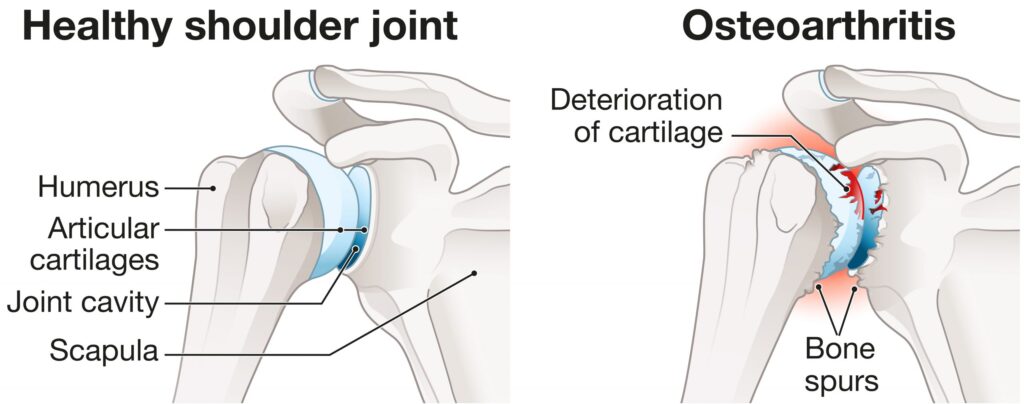
Shoulder osteoarthritis (OA) is a condition where the smooth cartilage that lines the shoulder joint gradually wears down over time. This cartilage usually acts like a cushion, allowing your shoulder to glide smoothly when you move it.
As the cartilage thins, the bones in your shoulder start to rub against each other, leading to pain, stiffness, and sometimes clicking or catching in the joint.
There are two main joints in the shoulder where osteoarthritis can occur:
- Glenohumeral joint – the ball-and-socket joint between your arm bone and shoulder blade
- Acromioclavicular (AC) joint – the smaller joint where your collarbone meets the top of your shoulder
Both can be affected, but glenohumeral OA tends to be the one that causes more significant pain and loss of function.
🧩 What Causes It?
There’s rarely one single cause. Instead, shoulder OA tends to develop over time, especially in people over 50. Contributing factors include:
- Previous shoulder injury or surgery (e.g. dislocation, fracture)
- Repetitive overhead activity (e.g. tradespeople, athletes)
- Family history of OA
- Inflammatory conditions like rheumatoid arthritis
- “Wear and tear” with age (although this term can oversimplify things)
It’s worth noting that you can have X-ray changes without symptoms, and vice versa—you might have significant pain with minimal imaging findings.
🔍 Common Signs and Symptoms
People with shoulder OA typically describe:
- A deep, dull ache in the shoulder
- Stiffness, especially in the morning or after rest
- Loss of range, like struggling to reach overhead or behind your back
- Creaking or grinding (crepitus) when moving the arm
- Pain with activity, especially lifting or loading the joint
- Difficulty sleeping on the affected side
Sometimes the pain can even radiate down the arm, which can be mistaken for other conditions like rotator cuff issues or frozen shoulder.
🧪 How Is It Diagnosed?
In the clinic, we look at:
- Your history and symptoms – how the pain started, what aggravates it, how it affects your life
- Clinical tests – checking your range of motion, strength, joint crepitus, and functional ability
If needed, we may refer you for imaging, typically:
- X-ray – to check for joint space narrowing, bone spurs (osteophytes), or changes in bone shape
- Ultrasound or MRI – more useful if we suspect co-existing rotator cuff involvement
It’s not just about what the scan shows—it’s about how your shoulder is actually functioning and how the symptoms impact your life.
🛠️ How Is Shoulder Osteoarthritis Treated?
The current evidence-based approach is tiered and personalised. Surgery is not the first-line option.
Instead, treatment usually begins with conservative care:
1. Education and Advice
Understanding your condition helps reduce fear and gives you a sense of control. We’ll explain what’s going on inside the joint and what you can do to manage it.
2. Pain Management
- Over-the-counter anti-inflammatories or pain relief (discuss with your GP)
- Heat or ice depending on what feels better
- Corticosteroid injection – can help short-term, but not a long-term fix
3. Physiotherapy (more on this below!)
4. Lifestyle Modification
- Adjusting movements or work tasks that flare your symptoms
- Finding ways to stay active while respecting your shoulder
5. Surgery (if needed)
If your pain is severe, constant, and not responding to conservative care, surgery might be considered—like shoulder replacement. But for many, this is the last resort.
🧘♂️ How Can Physio Help Shoulder Osteoarthritis?
We often see patients who are trying to avoid surgery and want a more natural, sustainable way to manage their pain. And the good news is—physio can help, a lot.
Here’s how:
✅ Reduce Pain and Improve Movement
Targeted techniques like:
- Joint mobilisation
- Soft tissue work
- Taping or offloading strategies
- Guided stretching and movement retraining
✅ Build Strength Without Flare-Ups
As cartilage wears down, the muscles around the shoulder need to work smarter, not harder. We’ll help you strengthen your rotator cuff and scapular stabilisers in a safe, graded way.
✅ Restore Function
We focus on movements that matter to you—whether it’s putting a shirt on without pain, getting back to golf, or lifting your grandchild.
✅ Prevent Flare-Ups
Learning how to manage load, recognise early signs of irritation, and adjust your activities can go a long way in reducing pain episodes and delaying progression.
🧠 What the Evidence Says
Multiple high-quality studies have shown that:
- Exercise-based rehab improves pain, strength, and shoulder function in people with OA
- Non-surgical management should be the first-line approach for most
- Surgery doesn’t always result in better long-term outcomes compared to a well-structured physio program, particularly for mild to moderate cases
A 2021 Cochrane review reinforced that physiotherapy and exercise therapy can meaningfully improve pain and function in shoulder OA—especially when paired with education and load management.
👋 Ready to Take Control of Your Shoulder Pain?
You don’t have to just “put up with it” or rush into surgery.
At Melbourne Shoulder Rehab, we specialise in helping people with shoulder osteoarthritis manage their pain, regain their movement, and return to doing what they love—without fear or guesswork.
📞 Book your assessment today
Let’s work together to get your shoulder back on track.